

So I was poopin around on my feed the other day, just making my merry way past the news of the day, when I stumbled upon an article by the New York Times: Energy Drinks are Surging, So Are Their Caffeine Levels.
I don’t personally drink energy drinks; coffee does the trick for me, and I’m not sure I’d find the taste of any energy drink appealing. But, still, this article intrigued me. It describes in detail the emerging “low calorie,” “sugar free” or other wise health-nut marketing angles energy drink companies have employed. But I don’t care about that. Let’s talk about, instead, the interesting component: caffeine. Before we continue, I will be talking a lot about caffeine in this post. If you care to learn more, or understand some of the stuff I refer to, I recommend you read this old post of mine: Caffeine: Workings, Overdose, Withdrawal.
The three energy drink kings are as follows: Red Bull, Monster, and Bang (as of 2021).
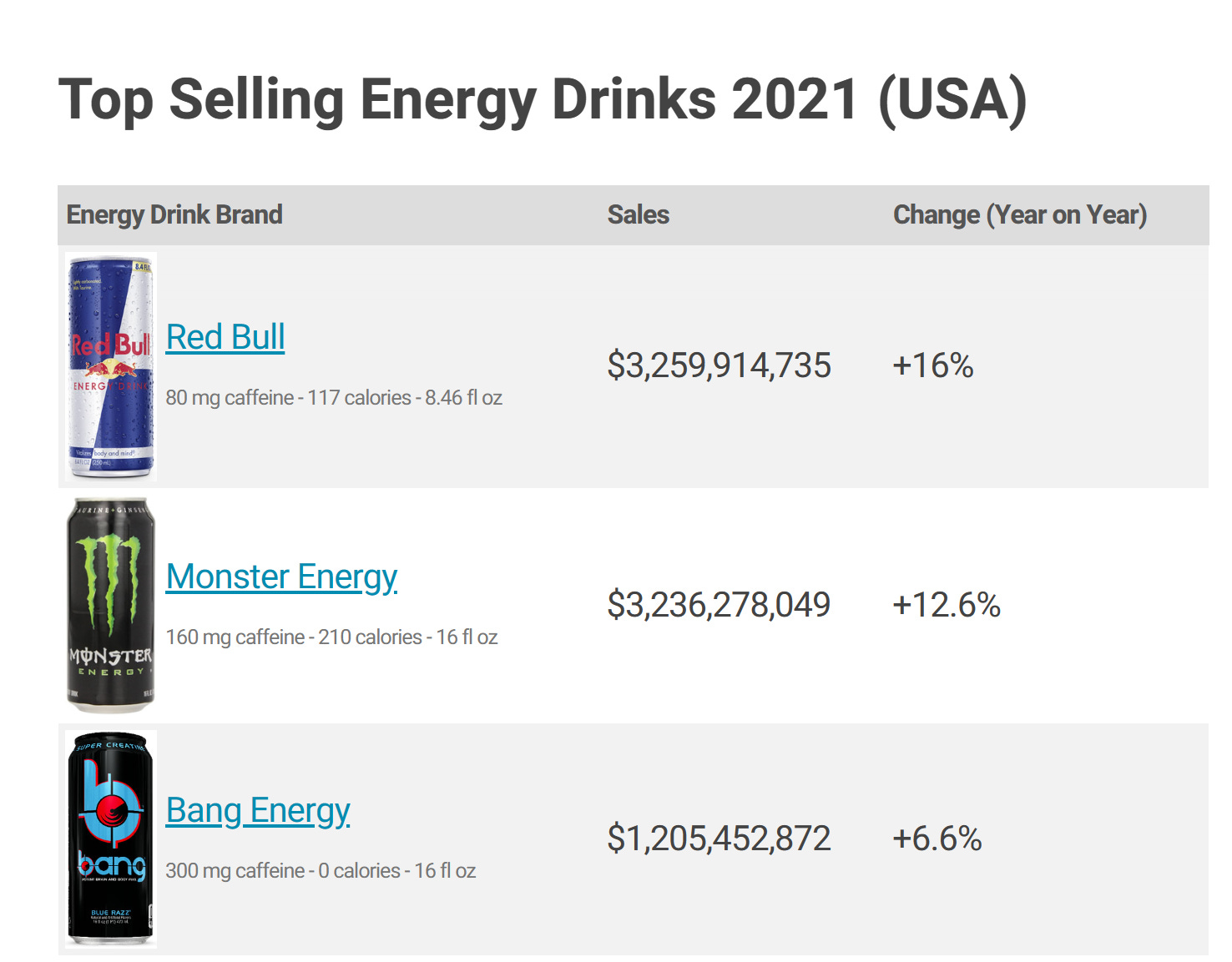
The order of their founding, from oldest to youngest, is the same. Each brand represents a different time in energy drink manufacturing and marketing, from the colors they brand with, their advertisements, blah blah blah but most importantly, THEIR CAFFEINE CONTENT.
You heard me right, as the NYT stated, the amount of caffeine in energy drinks is rising substantially. Notably, newer brands (post-2010ish) have drinks with higher caffeine contents to comparable drinks from older brands. To see this, let’s do a case comparson with those energy drink kings we mentioned, starting with the king of kings: Red Bull.
Red Bull: Caffeine King
Red Bull is the leading brand of energy drinks, single-handedly owning 42.5% of the energy drink market in 2021, selling around $6.85 billion of product. This market dominance isn’t too surprising, given Red Bull kinda invented the modern energy drink. Red Bull launched in 1997, making it the oldest energy drink brand that is still alive and kickin’ (side note: there is one energy drink that pre-dated Red Bull: Josta Cola - a Pepsi energy drink that was on the shelves from 1995-1999)
A 12-oz can of Red Bull has about 114 milligrams of caffeine. That’s about 1.5 cups of coffee, or slightly less than a double-shot (or a medium) latte. It’s kinda small potatoes compared to other energy drinks, even compared to coffee.
Monster (rawr)
Last year, Monster claimed 30.1% of the energy drink market. Monster was created in 2002, with their original energy drink containing 160mg of caffeine - wowza!
Oh, and Monster definitely bullied me in high school.
Guys, I’m not kidding. Monster is really mean and my feelings are hurt. First of all, the advertising is scary and I don’t like it. There’s claw marks, which implies a monster has been there, and that begs so many questions, including but not limited to: what is the monster? Is it a classified species? If not, have we notified science about this?
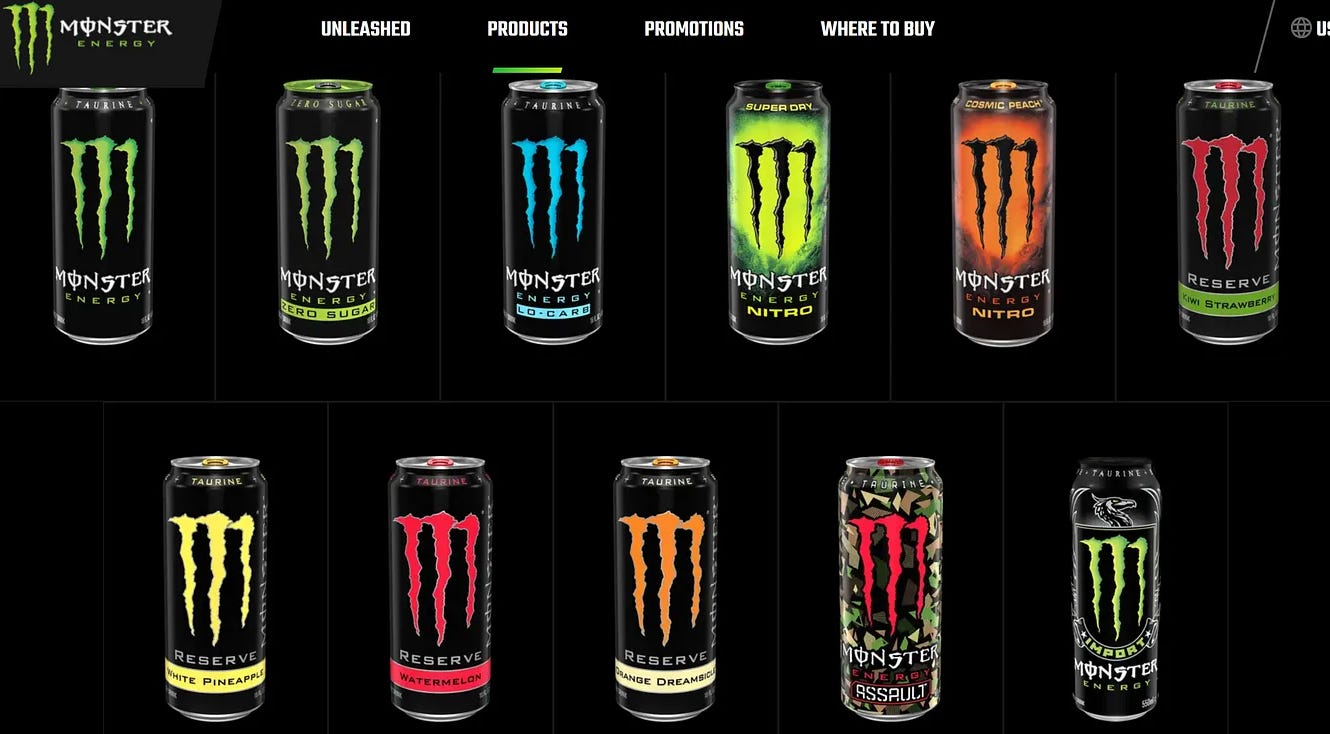
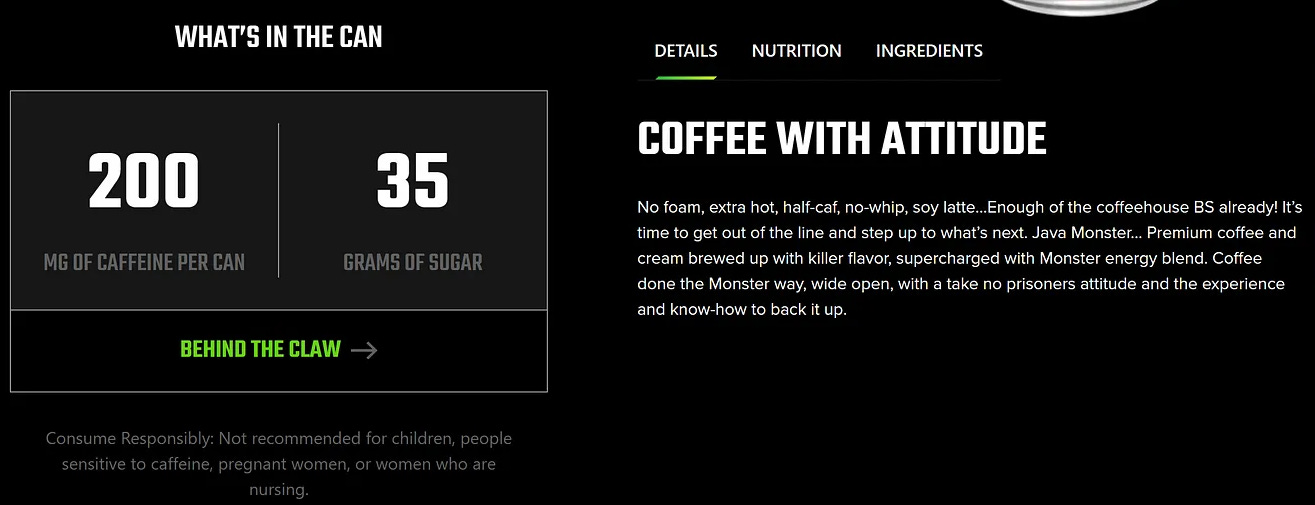
Secondly, they attack me personally. Monster has a coffee-energy drink line, called “Java Monster,” which is my superhero name BTW. A Java Monster drink is 200 mg of caffeine, which is about 33% more caffeine than a venti, or large, latte. Which is all fun and good except that they are mean again. The website specifically says, “Fork you Cass and your stupid forking coffee blog.”
Wait that’s not it. Lemme try again.
OH! It says, “Enough of the coffeehouse BS already.” Wow. Rude. Completely lacking respect for coffeehouse culture and caffeine freaks everywhere.
I was fully launching into this intending to give a straightforward deep dive into Monster vis-a-vis caffeine. But then their advertising distracted me and I need a good long nap to recover. I’m fine. It’s fine. Whatever. Moving on.
Bang Energy
Time travel to 2012 with me. A lot of stuff was happening in 2012. The end of the Mayan Calendar, for example. Apparently, the supposed end of the world did not bother Vital Pharmaceuticals, who banked on the world not ending to such a degree that they introduced Bang Energy that year. Or maybe they DID think the world was ending and wanted to go out with a… Bang… he he…
A Bang Energy drink has THREE HUNDRED MILLIGRAMS OF CAFFEINE
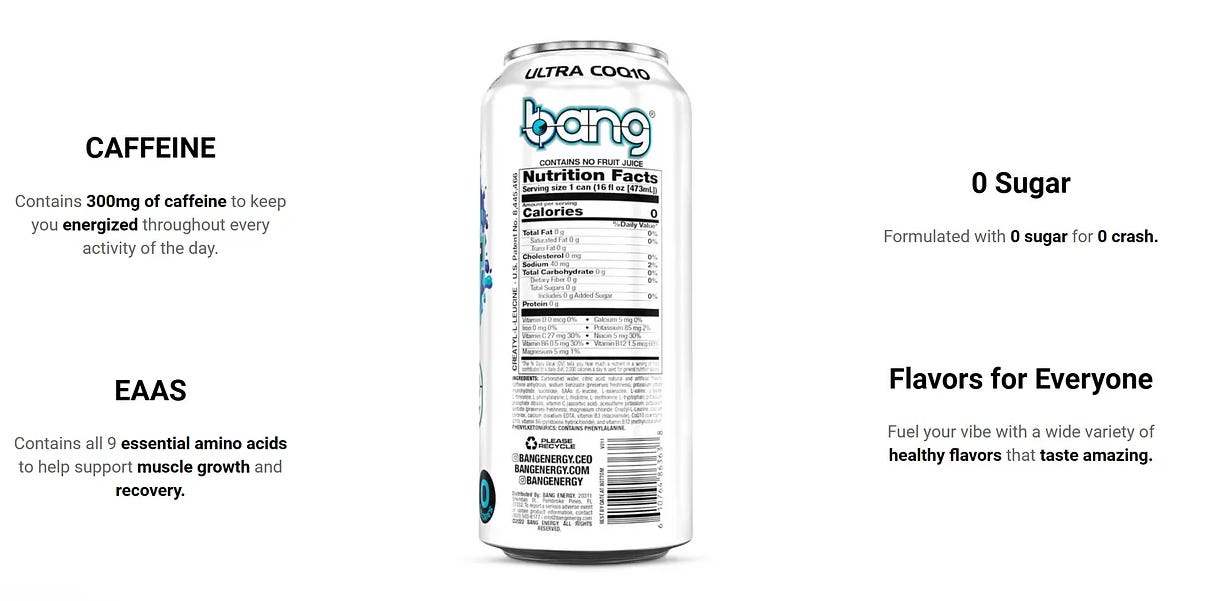
Did you hear me? Should I repeat myself? Let’s put it this way: generally, 400mg of caffeine is the maximum one should consume in a day. A 16oz Bang drink is 75% of the way there to that limit. That’s about five shots of espresso. Which is pretty preposterous for a single drink.
Notably, this particular Bang Energy drink I am looking at has 0g of sugar, and it’s advertised as “0 sugar for 0 crash.” Which is hilarious marketing. Technically they are correct in that 0g of sugar will not make me crash. That 300mg of caffeine, on the other hand…
In the end, it’s no coincidence that the caffeine content of the three biggest energy drinks in the US market today have an inverse relationship with their age. There are real market incentives to introduce drinks that are bolder, distinct from competitors, and more effective as an energy drink. Meaning, the caffeine levels are climbing. And I don’t necessarily think that’s a good thing.
While I’ll gladly joke about chugging coffee by the gallon, adding espresso shots in an IV, blah blah blah, caffeine is still a substance that (temporarily) alters your brains functions. Its main function is to intercept the ribonucleoside whose sole purpose is to help you feel sleepy when you need sleep. With this in mind, it can be put in a class of orally-taken substances that interfere with our bodies’ functions. Like ibuprofen, caffeine is orally taken in order to mitigate feelings we do not want to experience; while caffeine works to block ribonucleosides, ibuprofen blocks cells’ production of a compound that causes inflammation.
Similarly, caffeine is able to wedge itself in a ribonucleoside receptor to stave off sleep, mimicking a naturally-occurring compound in our brain in doing so. Similarly, THC mimics cannabinoid chemicals naturally found in the body, subsequently attaching to neurons in the brain and activating them.
I say this to point out that, just like ibuprofen and THC, caffeine can produce undesirable effects if over-ingested. Hell, ibuprofen is packaged with warnings, strict instructions, clear limits on how much should be taken at a time.
This should be kept in mind if/when the next energy drink brand rolls out a 16-oz “mega-stay-awake-shit-your-pants-caffeine-extravaganza” with 350mg of caffeine. Because, as the history of energy drinks suggests, other caffeine brands will see this and raise, not fold.
Alright y’all peace! See ya later, alligator